
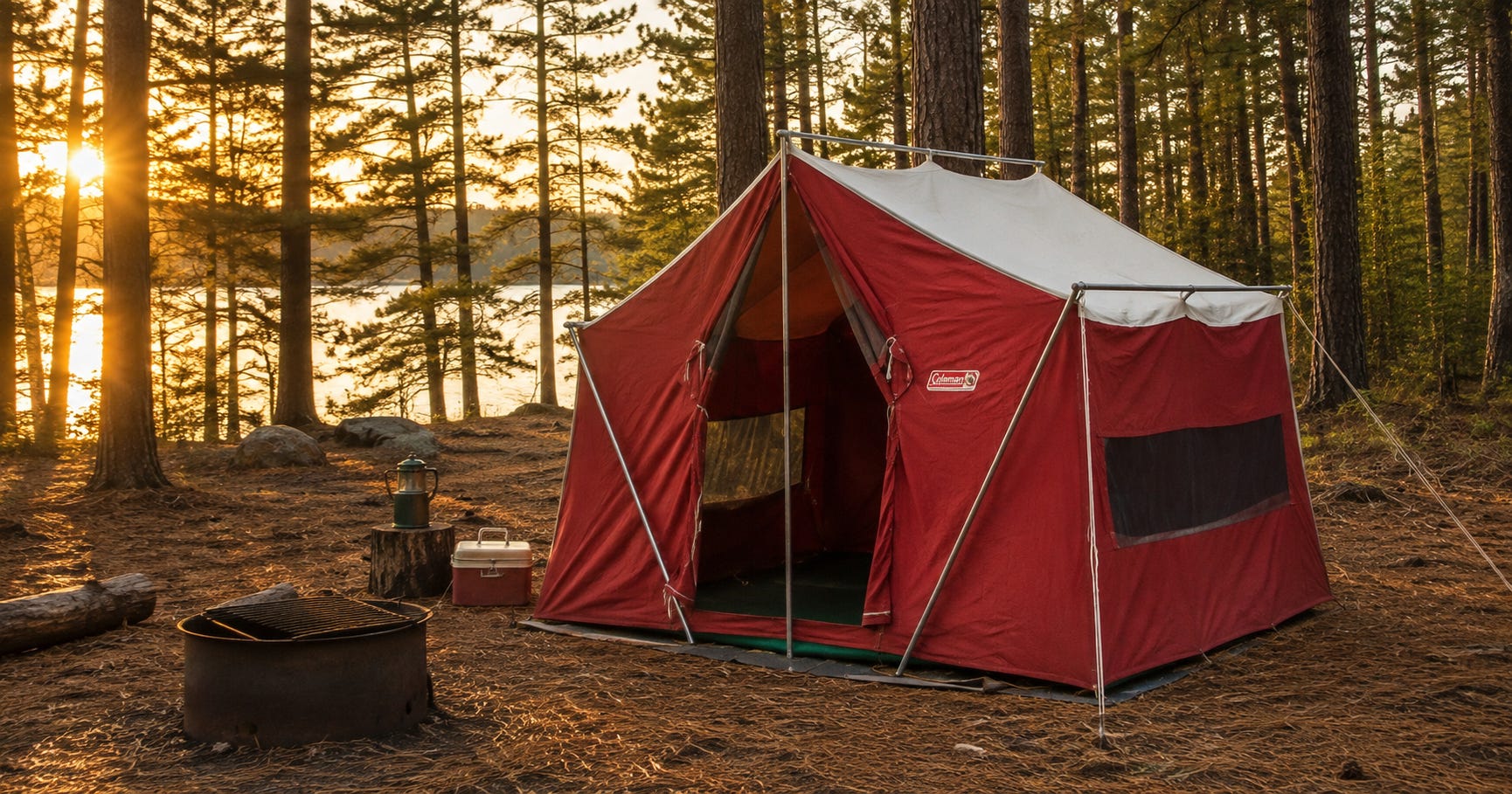
As a kid, traveling with my family meant heading north in Minnesota or across the river into Wisconsin to camp. My parents, brother, and I slept in an old red Coleman tent with a white canvas roof.
I was taught early not to touch the ceiling. Touch it and water would leak through. It made no sense to me. I touched it.
I woke up wet.
On another trip, my mom stood outside the tent screaming, “Water bucket! Water bucket!” It was all she could get out. A squirrel had fallen into the bucket we used to rinse dishes and drowned.
Those are some of my earliest memories of nature not playing favorites.
Camping was too slow for me. I liked movement, speed, crashing into things.
I remember watching from shore as speedboats took off pulling tubes and water skiers while we climbed into a canoe.
Why couldn’t we have a speedboat?
When I started making my own money, I went in a different direction. Cabins and horsepower became my thing.
Several years ago, my friend Mark invited me to join a small group backpacking through Pine Creek Gorge in northern Pennsylvania, a forty-some-mile stretch known as the Pennsylvania Grand Canyon.
Before we even hit the trail, we realized we were missing a backpack and a tent. The delay meant we’d reach camp well after dark.
I was surprised it didn’t bother Mark.
He had a philosophy I’ve found useful. Things rarely go as planned, and that’s part of the experience.
At our halfway point, Mark pulled water from a trickle of a stream and ran it through his gravity filter until there was enough for all four of us. I was new to backpacking, and watching stream water become something cold and drinkable felt like a miracle.
Carrying everything you need to survive on your back strips life down to the essentials. It’s almost strange how much I need in real life, and how little I need in the woods.
We averaged 12 miles a day. Spend that many hours walking with only a few people and you run out of surface-level conversation. Eventually there’s silence, or you walk yourself right into sharing things you normally wouldn’t.
On our first night, Mark had carried in frozen steaks and a small frying pan. We cooked steak and vegetables over a small fire.
The next morning, drinking coffee with friends in a beautiful place we could only reach by foot felt like a luxury of a different kind.
We packed up and left no trace that we had been there. It’s satisfying to glance back at a campsite that’s been well lived in to see it exactly as you found it.
Since that first trip, backpacking has taken me through the Tetons, Smokies, and Blue Ridge Mountains, along Lake Superior and across Oregon.
I learned a Japanese term that named what I had been experiencing in the woods. Shinrin-yoku, or forest bathing, is spending unhurried time in a forest and taking it in through your senses. It has a way of quieting the mind.
Part of what feels so good about the woods is that the noise and status disappear, and ultimately you surrender control.
One night in the Tetons, we set up camp while two large black bears picked berries a hundred yards away. They stayed there all evening. I remember crawling into my tent hoping they had no interest in us or our food.
After three days in the woods, you realize how little depends on you. Yet somehow we spend so much of our lives trying to prove otherwise.
We can signal importance through the lifestyle we build around us. That includes the clothes we wear, the cars we drive, the neighborhoods we choose, and the schools we put our kids in.
When our kids were young, we started looking for the right house to raise them in. Our realtor took us through a progression of homes, from older and less expensive to newer and more expensive. Each one was a little nicer than the last, which made it harder to go backward.
By the time we reached the newest, a model home in one of the wealthiest zip codes in the area, we were sold. The problem was that it all symbolized the life I wanted for us before we could reasonably afford it.
Once we moved in, I remember watching Megan drive off with our two young kids in the paid-for Volvo she adored. Several areas were starting to show rust, so we financed a new SUV.
When we discovered that some houses in our neighborhood had indoor sport courts, upgrading to a bigger house for several hundred thousand dollars more somehow felt like the right move.
Financially, those were some of the toughest years of our lives. Megan had a steady paycheck while I was starting and growing businesses, so our income could swing wildly. Instead of giving ourselves more room, we kept adding expenses. We had created a life that looked better than it felt.
We can also signal importance through what we tell people about ourselves.
We work our title into conversation, mention someone well known, make sure people know how much depends on us, or share what our kids have accomplished. Social media gives us another place to broadcast it all.
When I was recruiting young employees from local colleges, I often reached out through coaches and athletic directors. I changed the title in my email signature to Founder and CEO so they knew the message wasn’t coming from an entry-level recruiter. Both titles made me seem bigger than I really was. It worked, so I left it there.
Titles can open doors. Looking successful can change how people respond to you. Sometimes those signals are useful.
But they can come with a hidden cost.
In our office building, I had the largest corner office, with a conference table and a sitting area where I met one-on-one with people. Add the title I was actively promoting and it all looked pretty important.
More than once, after someone got to know me, they admitted how intimidated they had been to walk into my office. Hearing that bothered me. The image that gave me authority also created distance.
There’s a woman at my gym who takes business calls loud enough for everyone around her to hear. The sign on the wall says no phone calls.
I speak to a lot of people at the gym, but not her. She intimidates me. I’m sure she’s perfectly nice.
We can also use signals to rank other people.
I played college hockey at a program that recruited heavily out of junior hockey. A few of us came straight from high school.
When I walked into that locker room, the hierarchy was already set. The guys who had played juniors belonged. Those of us straight from high school hadn’t proven anything yet. Some of the older guys barely acknowledged us.
For most of my professional life, I stopped on the way to work for a Diet Mountain Dew. I gave the guy behind the counter very little of my attention. If I’d found out he was deciding who made my son’s hockey team, I’d have been a lot more interested in him.
We can pass over people who don’t seem important to us. We don’t give them our time or attention unless they prove they belong or can advance us.
Last year I took my youngest son, Zach, to Vikings training camp. We stopped for gas on the way home. He came in with me and didn’t come out. Ten minutes later he got in the car and told me which Vikings stop at that station and what time of day they come through. The attendant had offered to keep a stack of his cards behind the counter and get them signed.
We’re having our garage painted. The other day Zach disappeared for a half hour to talk to the painter. He came back knowing how many cans it takes, what kind of paint they’re using, why they use it, and what it costs.
He’s eleven and hasn’t learned yet who’s supposed to get more of our attention.
Last summer, as I neared the exit of my businesses, a mentor of mine ended a phone call with, “Oh, one more thing. You should read Beyond the Exit. It will prepare you for the quiet you’re about to experience.”
While this was true, the book also helped me discover how much my sense of importance was tied to work.
On Wednesday and Thursday of the week the sale closed, my email and texts hit an all-time high. My attorney was in touch every fifteen minutes as she worked through the final documents. By Thursday afternoon it was done and I was no longer a business owner.
By Saturday morning my phone had gone quiet. Two days.
Meeting requests, lunch invitations, entertainment events, golf outings. They thinned out over the following weeks until they mostly stopped.
People who had called on me for years no longer needed me. It wasn’t that those relationships weren’t real. But need and proximity had been doing a lot of the work, and both were gone.
I had spent most of my adult life thriving on being needed. I liked the pace, the responsibility, the problems to solve.
A friend who had sold his business said to me weeks earlier, “Every day for the next year, it will feel like you take one more pack off.”
That Saturday I sat on the screened-in porch at our cabin with a cup of coffee and Megan. The sun was peeking through the pines on one side of me, the lake quiet on the other. Nothing needed me.
Maybe the quiet will feel different someday.
But that morning, taking the first pack off felt pretty damn good.
One fear is that if we stop trying to be important, we may leave less of a legacy.
I once watched a group exercise where people were asked to fill in a family tree from memory, starting with their parents, then their grandparents and great-grandparents. Most could make it through their grandparents. After that, the names started disappearing.
These were people whose lives once meant everything to those around them.
Nearly every teenager today carries a smartphone, a device that has changed how we all live. Steve Jobs was one of the people most responsible for putting it in our hands. He died in 2011.
Ask your kids who Steve Jobs was.
If most of us will fade from memory anyway, we can worry less about proving ourselves and more about living the life we actually want.
Being remembered and having an impact are not the same thing.
My parents introduced me to the outdoors long before I understood what they were giving me. At the time, I mostly remember the campsites, the canoe, and the slow pace of it all.
Decades later, I found my way back to the woods on my own.
And that wasn’t all they passed on.
My parents lived well below what they could afford. That old red Coleman tent was one example. They could have replaced it long before they did.
My dad was a preacher, a writer, and a storyteller. I can tell you what he believed about integrity, loyalty, the role of a father, even what he could find in something as ordinary as sitting in a pile of dirt.
My mom sees everything. The birds, the plants, all of it by name. She also notices when someone does something extraordinary. She is one of the rare people who tells them.
Their names won’t be attached to all the ways they show up in my life. But I carry forward a lot of what they gave me.
Zach was four when he met our neighbor Nate at the bus stop, where a group of parents and kids gathered most mornings.
Like he does with most people, Nate took an interest in Zach, throwing him long bombs with a mini football and talking sports. Nate’s wife, Brittani, tells the story of finding Zach in their pantry rummaging through their snacks.
I was hosting the season kickoff party for my oldest son Beau’s squirt hockey team. I asked Nate to come over and talk to the kids about his hockey journey.
When he arrived, the players went crazy. Minnesota Wild defenseman Nate Prosser was here.
Zach was running around the basement yelling, “Nate Prosser is here! Nate Prosser is here!”
Then he climbed to the top of the stairs and stopped. He looked at Nate, then at me, trying to reconcile the NHL player everyone was excited about with the neighbor he knew from the bus stop.
“Wait, you’re Nate Prosser?”
Then he turned around and headed back downstairs, like, Oh. That guy. That’s just Nate.
Zach had spent months around someone who was living an extraordinary life, and Nate had never needed him to know it.
Brittani, a fitness enthusiast, once asked if she and Nate could borrow our weighted backpacks for a walk. Nate asked how much weight was in mine. When I told him sixty pounds, his eyes widened. Brittani told him he’d be fine.
About an hour later, they rounded the corner. Brittani was moving along briskly while Nate trailed behind, looking considerably less enthusiastic.
He walked into my garage with the back of his shirt soaked in sweat, dropped the pack, and said, “Well, I don’t ever need to do that again.”
They have four daughters who play hockey, so their family spends a lot of time at the local rink.
Megan calls Nate the mayor of the rink. It’s hard to find him there without a group of people around him.
Nate could spend his time inside the circle of elite athletes he played alongside. But he’s just as likely to be down the block talking with a service tech working on a neighbor’s house.
The less Nate seems to care whether people see him as important, the more people are drawn to him.
Being unimportant doesn’t have to be about shrinking your life. You can still build things, buy things you genuinely enjoy, have influence, and leave an impact.
That’s what I like about leaving a campsite the way we found it.
You can spend days there. Eat, sleep, talk, laugh, struggle, recover. The experience can stay with you long after you leave. There doesn’t need to be any evidence that you were there.
Maybe one of the greatest compliments we could receive is:
“Wait, you’re Nate Prosser?”