
My dad used to say how lucky he felt because there was no one he’d rather spend time with than his family. I was too young then to fully understand what he meant.
Now that I have a family of my own, I feel lucky to say the same.
Which is one of the reasons I love summer at our cabin. It brings together the people I most want to be with, a beautiful place surrounded by nature, and the activities that make me feel most alive.
Our cabin started as a hunting shack. Over the years, a couple of small bedrooms and one bathroom were added, and the garage became a bunkhouse with triple-decker bunks that sleep fourteen.
We sit between two lakes. Mud Lake, across the road, is always glass-calm. Devil’s Lake, all 900 acres of it, sits at the bottom of a yard that slopes down to a sandy beach.
Although each day is different and often shaped by the weather, we have our routines. Mornings start with great coffee and conversation on the screened-in porch. As the kids wander out of the bunkhouse and across the yard, we greet them with a cheer, ask what adventures took place after the adults went to bed, and hear what they’re hoping to do that day.
Evenings usually mean a big dinner around the farm table, often from a smoker that has been filling the air all day, followed by a bowl of ice cream covered in way too much Hershey’s syrup. I’m sure that somewhere alongside family, friends, and fun, our kids’ cabin memories will include a lot of ice cream.
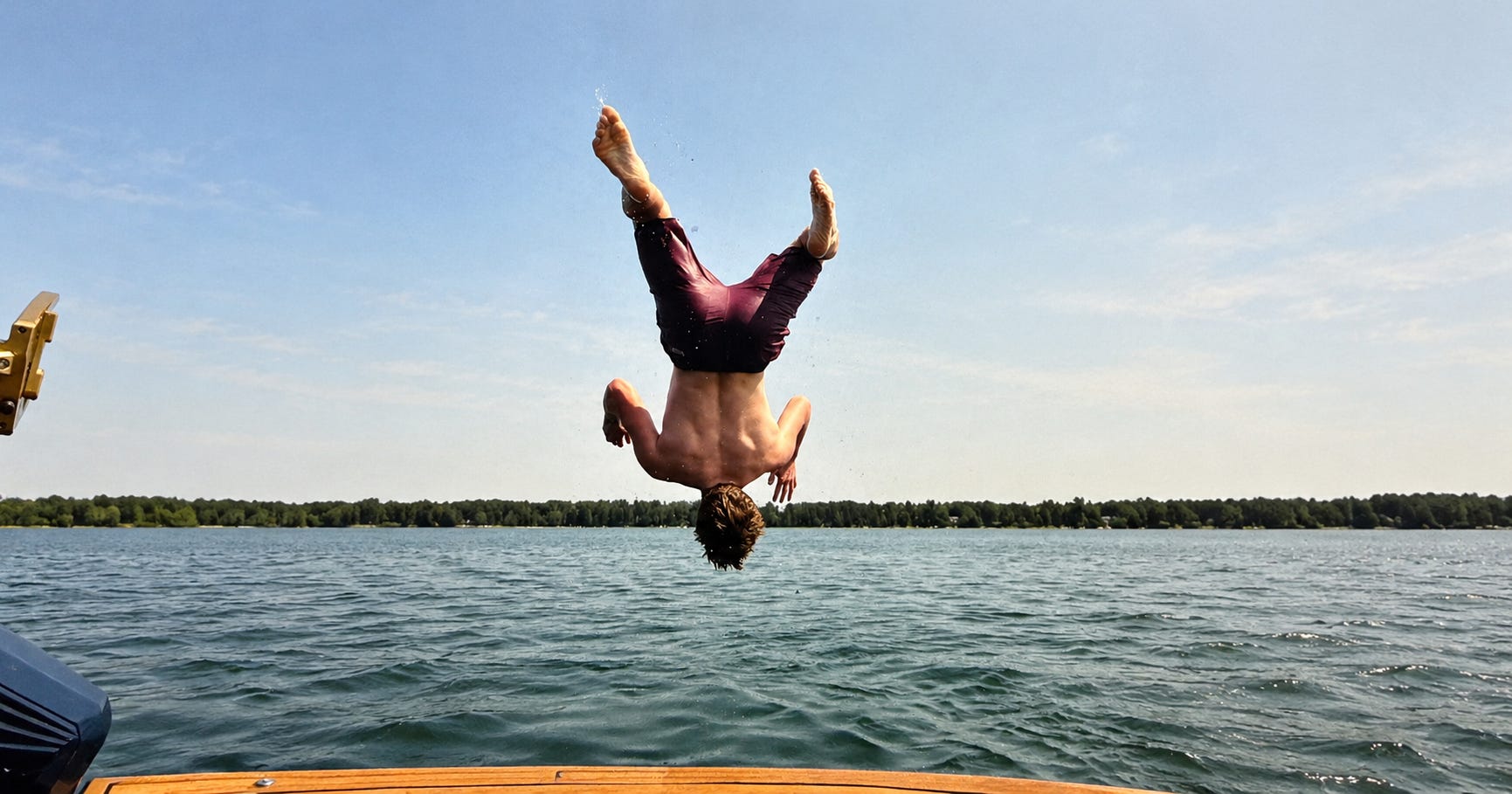
What happens in between varies from day to day. If the lake is calm, we take out the paddle boards. If it’s windy, we grab the mountain bikes and head into the woods. The boat and jet skis come and go with different captains to tube, wakeboard, surf, or turn the middle of the lake into a swim party.
And then there are the things nobody plans.
A normal game of cornhole somehow evolves into a high-velocity game of throwing footballs at the boards. Golf is played with sponge balls by picking a tree, declaring par, and figuring it out from there.
One afternoon, I glanced down the shoreline and saw what looked like a row of little buoy heads in the water. It was a group of our boys standing shoulder-deep in the lake, fishing, with just their heads and rods sticking above the surface.
Another day, Megan sat cross-legged on a paddle board, slowly making her way across the water, with our 11-year-old Zach draped across the back, his butt in the air and his goggled head submerged.
I later learned they were hunting for golf balls.
Of course they were.
Then Labor Day shows up, and it all abruptly ends.
If you want to catch me at my lowest emotional point of the year, it’s the week after.
The scenes, sounds, smells, and energy that filled the summer are suddenly replaced by a quiet house. The kids are back in school, out the door early, and quickly absorbed into sports, homework, and everything else that comes with fall.
As summer comes to an end, we all seem determined to squeeze in a little more.
I had wanted to do a lake misogi all summer. The modern version is to take on an adventure where success feels about 50/50. One important rule: you can’t die doing it. I just couldn’t decide what ours should be.
Knowing it was our final weekend, I grabbed a cinder block and pitched Beau and his high school buddies on moving it 300 yards under eight feet of water in less than 30 minutes. They did it in 18. Bree and her friends wanted in, then Zach and his friends followed.
They all beat my completely arbitrary time goal, but it wasn’t easy. They came out scratched and a little bloodied from wrestling with a cinder block that kept disappearing into the weeds.
Megan had set a goal of getting up on the surfboard but hadn’t tried for weeks, partly because of a lingering fear from childhood experiences behind a boat.
That same weekend, I called out, “Who’s up next?” Megan, normally my first mate handling the boards, life jackets, and rope, already had the surfboard tucked under her arm.
“I am.”
A friend once described the perfect way to end a vacation. On the last day, you want to be wishing for one more day. Ending while you still want more can help preserve what made the experience special.
The end also creates anticipation for what comes next. As summer winds down, I start planning fall backpacking and golf trips, thinking through projects around the house, and outlining my coaching plan for the upcoming hockey season.
We usually book a spring break trip somewhere warm in the fall, giving us five months to look forward to it. By February, when everyone is worn down by a Minnesota winter, the excitement builds. After the trip, we relive it through stories, pictures, and memories that become part of our family history.
In some ways, we get to enjoy the same experience three times. We anticipate it, we live it, and then we remember it.
Summer has Labor Day, but most of life doesn’t. Nothing tells us when something has run its course, so we keep going.
It happens with relationships.
I remember first coming across a quote attributed to Jim Rohn that says, “You are the average of the five people you spend the most time with.” I had never really thought about who my five were or how they might be shaping me.
I eventually started using the quote in team-building sessions. I’d ask everyone to privately think of their five people, then count through the list while they held up a thumb. Up if that person made them better, sideways if the influence felt neutral, down if it was negative.
The first person was usually a thumbs-up, but not always. By the second and third person, more and more thumbs had shifted sideways or down.
I wasn’t asking anyone to cut their friends loose. I wanted them to notice who they spend their time with and what those people add to their lives.
Most of us never really choose our five. We collect them through school, work, teams, and neighborhoods, and then keep them out of habit.
Looking back, my life has moved through phases. In high school, I cared mostly about sports and very little about grades. In college, academics became important, then my career took over much of my focus. Alcohol, and all the highs and lows that came with it, showed up in my 20s and 30s before I met Megan and we started a family.
The best phase of my life has been building my family and learning to take care of myself, mentally and physically, so I can live life more fully and show up better for them and for others.
Through each of those phases, I had wingmen, people who fit that version of my life. But the people who were right beside me in one season are not necessarily the people who make me better in the one I’m in now.
The same thing can happen in our careers.
My brother and I were making our way through the Theodore Wirth mountain bike trails. He rides at a faster clip than I do, which is hard for me to admit. He’s my younger brother.
Every so often, he stopped to wait for me, and we used those moments to catch up on life.
He has spent years in an organization with a compelling vision, one he’s made real sacrifices to support. I spent ten years with one company and twenty with another, and both inspired the same kind of commitment in me.
At one of our stops, I commented on how different our lines of work were, yet how similar our experiences had been. He looked at me and said, “Isn’t that what good leaders do? Get people to line up behind a compelling vision.”
He’s right. And once we’re lined up, it’s easy to stay there. There’s no horn at the end of each period asking whether this is still the right path, or reminding us how many others are out there that we may never get to try.
It also happens in our daily routines.
Beau is a high school senior. When he walks through the front door, I sometimes see an imaginary number 1 over his head. The 1 is for the number of years he has left living in our house.
Since the day he was born, I’ve resisted saying, “Wow, time sure has flown by.” Seventeen years doesn’t just fly by. We’ve packed a lot of life into those years.
Having kids and building a family pushed Megan and me deeper into routines. Between school, sports, meals, work, and everything else that keeps a family moving, they’re one of the only ways to manage it all.
But routines can also put life on autopilot. When that happens, time does fly by, and other important parts of life can get crowded out.
Some of the things that originally brought Megan and me together have received less attention along the way, like date nights, shared adventures, and great conversations where we lose track of time.
Nobody called out the last diaper change or the last ride to practice. One day the need for them disappeared. But we never went back to the things we loved doing together.
So we’re making room for them again.
And then there is fear.
Even when we recognize that something may need to change, it’s easy to focus on everything that could go wrong.
When we started tossing around the idea of moving our family from Minnesota to Oregon to try something new, I could feel the fear underneath all the reasons not to leave. Around that same time, Chase Jarvis’s book Never Play It Safe found its way into my hands.
Jarvis helped me see that staying the same can actually be the bigger risk. In trying to protect what we have, we can leave a lot of life unexplored.
That’s part of what I love about a misogi. When the odds are 50/50, falling short is part of the deal. Over time, your brain learns that failing isn’t the end of the world, and trying something new gets a little easier.
We spent a year in Bend before moving back to Minnesota, and I’m grateful we did both.
On our last weekend at the cabin, Bree and two of her friends climbed onto the boat for one final surf. Almost immediately, they started calling out all the lasts.
“This is the last time you’ll step onto the boat.”
“This is the last time you’ll put your drink in the cup holder.”
“This is your last surf.”
When the final run was over, they sat together on the back of the boat, looking out at the lake.
“I got so much better this summer.”
“I’m sad it’s over.”
Then, after a long pause, almost on cue.
“I can’t wait until next summer.”
“I’m locking in.”
“Me too.”